Jewelry Design Software Compared: Rhino, MatrixGold, 3Design and More
Rhino, MatrixGold, 3Design, ZBrush, Blender and Fusion compared from each maker's own site: price, platforms, file formats, jewelry tools, and what your caster needs.
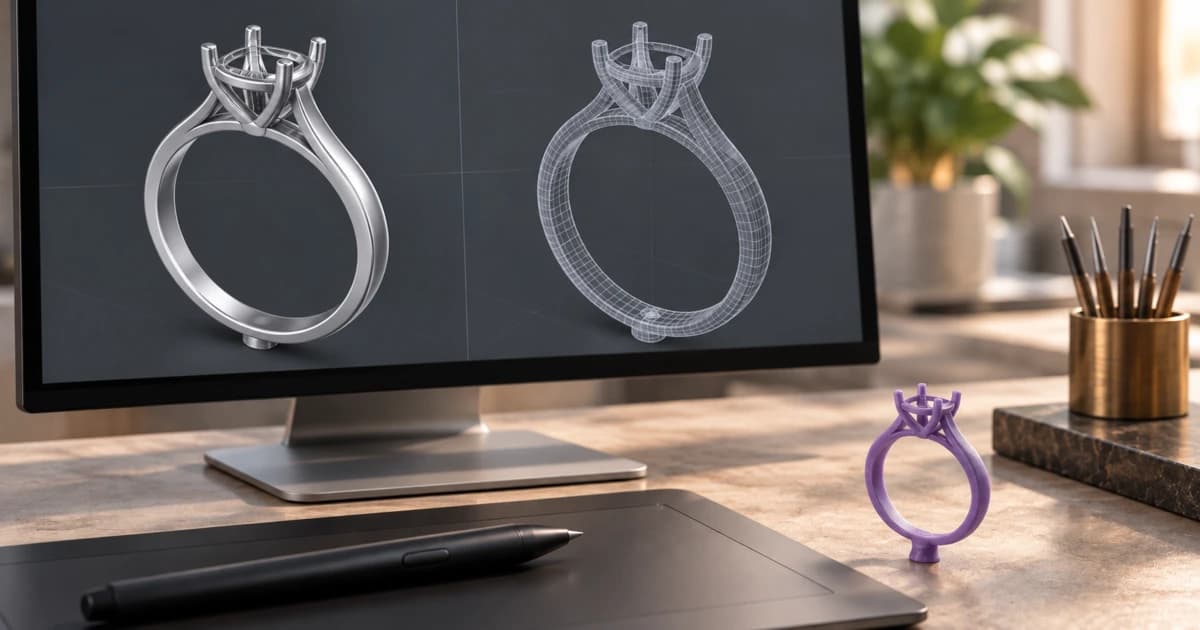
Jewelry design software comes in three kinds. There's Rhino and the jewelry plugins built on it (MatrixGold, and the older RhinoGold). There's dedicated jewelry CAD such as 3Design. And there are sculpting and general 3D programs such as ZBrush, Blender and Fusion. Within those, the differences that decide a purchase are price, whether it runs on your computer, and which files it hands to your caster.
Most "best software" lists skip those three things. The table below doesn't. Every price, platform and file format comes from the maker's own website, read on 15 October 2026. Where a maker doesn't say, the table says "Not listed".
The programs side by side
Jewelry CAD software at a glance. Prices are US list prices on the maker's site, 15 October 2026.
Program (maker) | What it is | Runs on | Price and license | Saves and exports | Jewelry tools (maker's words) |
|---|---|---|---|---|---|
Rhino 8 (McNeel) | General NURBS modeler: curves, surfaces and solids | Windows and Mac | US$995, permanent license, no maintenance fees; upgrade from an older version US$595 | Saves .3dm; opens and saves STL, STEP, IGES, OBJ, FBX, glTF | Not listed; jewelry plugins run on it |
MatrixGold 4 (Gemvision) | Jewelry plugin built on Rhino | Windows 10 or 11 (not ARM) | $5,995 with Rhino 8; $5,495 without. Includes a six-month membership; after that, an optional annual membership | Exports STL, 3DM and OBJ | Gem placement, profile builders, pattern libraries; gem maps, material lists, tech reports |
RhinoGold (replaced by MatrixGold) | Older jewelry plugin for Rhino | Not listed | No longer supported by Gemvision; MatrixGold is its successor | Its files import into MatrixGold | — |
3Design V13 (Gravotech) | Dedicated, parametric jewelry CAD | Windows 11 Pro 64-bit, or a Mac with Apple silicon (M1 or later) | Price on request (a local rep calls); protected by a USB security key | Pro edition: STL, IGES, STEP, OBJ (maker's 2021 page). Designer edition: no production formats | Parametric finger size, stone and prong tools, pavé, variable channels, caliper that weighs the metal |
JewelCAD | Dedicated jewelry CAD | Not checked | Not checked | Not checked | Not checked |
ZBrush (Maxon) | Digital sculpting ("virtual clay") | Windows (including on Arm), macOS, iPadOS | Yearly subscription per license; price shown by region. 14-day trial | "Standard 3D geometry formats" (no list on the product page) | Maxon names jewelry as a use; no jewelry-specific tools listed |
Blender (Blender Foundation) | General 3D, free and open source (GPL) | Windows, macOS, Linux | Free, including for commercial work | Saves .blend; imports and exports STL | Not listed |
Fusion (Autodesk) | Cloud CAD, CAM and engineering | Windows 11, macOS 15 or later | US$680 a year or US$85 a month. Free personal-use version for non-commercial work | Personal-use version has limited import and export types | Not listed |
Two sums from the table are worth knowing. MatrixGold without Rhino plus a new Rhino license costs $495 more than the bundle, so buy the bundle unless you already own Rhino 8. And Fusion at $680 a year costs more than Rhino's one-time $995 from the second year on, though Rhino will need a paid upgrade at some point (more below).
Rhino and the jewelry plugins built on it
Rhino is the base that MatrixGold, and RhinoGold before it, run on. McNeel describes it as software to "create, edit, analyze, document, render, animate, and translate NURBS curves, surfaces and solids". NURBS are exact mathematical curves and surfaces, not a mesh of triangles. McNeel lists jewelry among the things people use it for.
As 3D jewelry design software, Rhino has three strengths:
One payment. McNeel's sales page says "All purchased licenses are permanent and do not expire" and "There are no maintenance fees." The catch is in the same note: a new computer or operating system "may" mean buying an upgrade.
Windows and Mac. The same Rhino 8 license covers both.
Other programs can read its file. Rhino saves .3dm, and MatrixGold exports 3DM too. McNeel publishes free openNURBS tools that read and write the 3DM format, so other programs can open it.
What plain Rhino lacks is jewelry tools: gem libraries, ring-size builders, prong and pavé tools. That's what the plugins add.
MatrixGold is Gemvision's jewelry plugin. Stuller sells it on its own site and runs the casting service it connects to. Gemvision's FAQ says "MatrixGold is built on Rhinoceros, and a valid Rhino license is required." It adds gem placement, profile builders and pattern libraries, and it makes gem maps, material lists and tech reports. MatrixGold 4 costs $5,995 with Rhino 8 or $5,495 without it, on Gemvision's store. A six-month membership comes with the license. After that the membership is an annual extra, and Stuller's FAQ lists software upgrades among its benefits. Two practical limits: Gemvision's requirements page lists Windows 10 and 11 only, and a license "can only be activated on one device at a time". Gemvision offers a 15-day trial to qualified users in some regions.
RhinoGold was the other big Rhino plugin. Stuller now says MatrixGold "combines the best features of RhinoGold and Matrix", and that Gemvision "no longer offers technical support for Matrix or RhinoGold". If you still use RhinoGold, Gemvision says MatrixGold imports legacy RhinoGold files, "preserving most geometry and design data". We couldn't read RhinoGold's own website, so we don't quote a price for it.
Want to try Rhino first? McNeel's evaluation runs 90 days. After that, McNeel says, "you'll need a license to save files or run plug-ins."
Dedicated jewelry CAD: 3Design and JewelCAD
3Design doesn't sit on Rhino. Gravotech builds it as a parametric jewelry program: change the finger size, and the parts linked to it follow. Its feature page lists a parametric finger-size feature, stone and pavé-prong tools, a variable channel tool, and a caliper that "weighs and computes the amount of material you will need to cast".
Three things to know before you call for a quote:
No public price. The FAQ says to fill in the contact form, and "a representative in your zone will call you". The site's "What is the 3DESIGN's price?" link goes to that form.
Mac or Windows. The technical specifications for version 13 list Windows 11 Pro 64-bit and Apple-silicon Macs (M1 or later). An older Intel Mac is not on the V13 list.
Edition matters for production. The maker's 2021 edition page says the Pro version exports "IGES, STEP, OBJ and especially the STL format", while Designer "has all the features of the Pro version except for the production file formats". Ask which edition exports STL today before you buy.
The license is protected by a USB security key (a dongle). The FAQ says it ships with one.
JewelCAD appears in most jewelry CAD lists. But on 15 October 2026 neither jewelcad.com nor jewelcadpro.com opened as a working maker's site, so its row in the table says "Not checked". Check price, platforms and formats with a dealer before you commit.
Sculpting and general 3D: ZBrush, Blender, Fusion
None of these three is made only for jewelry, and none lists jewelry tools such as gem libraries or ring sizing.
ZBrush is for sculpting. Maxon says its brushes "allow you to work with polygons the same way you would with actual clay". Maxon's ZBrush page pitches it for jewelry too: "Precise, detailed forms for jewellery and product design, ready for production." What the page doesn't list is jewelry-specific tools such as a gem library or ring sizing. It runs on Windows, macOS and iPad, and one license covers desktop and iPad. It is sold as a yearly subscription per license, and Maxon shows the price for your region. There's a 14-day trial.
Blender is free. Its license page says "Blender is released under the GNU General Public License" and "What you create with Blender is your sole property", so you can sell what you make with it. It runs on Windows, macOS and Linux. The manual says STL is "useful if you intend to import/export the files for CAD software" and for 3D printing. Blender's makers list no jewelry tools, so there is no gem library and no ring sizing unless you add them yourself.
Fusion is Autodesk's "professional cloud CAD, CAM, CAE, and PCB software", at US$680 a year or US$85 a month. The free personal-use version is "for personal, non-commercial projects only", for people earning "less than $1,000 USD annually" from it, and it has "limited import/export file types". So if you sell jewelry, the free version is not for you.
Free ways to start
If you want free jewelry design software, there are five options, and two of them, Blender and FreeCAD, are clearly free for business use:
Blender: free for any use, including commercial work. It has no jewelry tools of its own, but the free JewelCraft add-on (GPL-3.0) creates gems, prongs and cutters, calculates weight in a variety of precious alloys and makes a gem map.
FreeCAD: an open-source parametric modeler, licensed LGPL-2.1. Its makers say the files you make with it "are truly yours, forever", and it exports STEP, IGES, OBJ and STL. Its pages list no jewelry tools.
Rhino's 90-day evaluation: the full program, then you need a license to save files.
Fusion for personal use: free, but non-commercial only.
Tinkercad: Autodesk's "free web app for 3D design, electronics, and coding". Some lists call it open source; Autodesk's page says free use "is subject to acceptance of and compliance with the Terms of Service".
Which files each program makes, and what your caster needs
Each program we could check hands a caster a different set of files.
If you design in… | You can send… |
|---|---|
Rhino | .3dm, or STL, STEP, IGES, OBJ |
MatrixGold | .3dm, STL or OBJ |
3Design Pro | STL, IGES, STEP or OBJ (Designer edition: none of these) |
ZBrush | "Standard 3D geometry formats" (check the format list in the app) |
Blender | STL (and its own .blend, which casters won't need) |
Fusion | Full version: not listed here, so check STL export with Autodesk. Personal use: "limited import/export file types" |
What casters ask for varies, so ask first. Two published examples:
Stuller's CAD/CAM service prefers "3dm NURB" files, "not unioned/joined; not one solid mesh", says "STL files are accepted", and asks you to "leave gem-stones in the files". Gemvision says MatrixGold files can go "directly" to that service.
Cooksongold, in its casting design guidelines, asks you to "export the model to a high resolution stl".
So STL is the format both casters take, and Stuller prefers 3DM. 3Design itself calls STL "the rapid prototyping standard used by 3D printers". If you design in a program that can't export STL, such as 3Design's Designer edition, the maker says files can be sent "to a professional version or to one of our certified Service Offices".
Before the file leaves, check the jewelry inside it: the metal weight, the stones and the thin spots. Our guide to calculating gold weight from a CAD file shows how to get the weight from the model's volume.
Sharing a design with someone who doesn't own the software
Your caster, your client or a salesperson may not own Rhino, MatrixGold or 3Design. A $5,995 license to look at one ring isn't an answer. Here is what each side can do.
Send a format they can open. Ask what they use. STL is the common choice: Rhino, MatrixGold, 3Design Pro and Blender all export it, and it's the format 3D printers take.
Use the maker's own viewer, if there is one. 3Design sells Boutique, an in-store viewer that loads your 3Design library. Its page says it runs on Windows tablets only.
Let them open the file in a browser. Culet Studio opens Rhino .3dm (including MatrixGold files saved without render meshes), STEP, IGES, STL, OBJ, FBX, PLY and GLB/glTF. Nothing to install. The file is read and measured in your browser; it's stored on Culet Studio's servers only when you save it to your Drive, share it by link, or export a live 3D or 360° view. It shows the weight in 10 alloys, every stone with an estimated carat, and the ring size for rings. It can also render product photos or a 360° spin to send to the client. Zipped or password-protected files don't open, and the file formats section of the docs lists what does.
Culet Studio is ours, so weigh that. It also doesn't model or edit anything: you still design and fix the piece in Rhino, MatrixGold or your usual CAD program. It's free for everyone, with a small credit line. The files section on the features page explains how big files open.
The best jewelry design software for your kind of work
There isn't one best program. There's a best fit for the work you do and the computer you use. These are our recommendations, each based on the facts above.
You are… | Start with | Why |
|---|---|---|
A custom or bench jeweler on Windows, making settings with stones | MatrixGold (with Rhino 8) | Gem placement and profile tools on top of Rhino; exports STL and 3DM; links to Stuller's casting service |
A jeweler on a Mac | Rhino 8, or 3Design V13 on Apple silicon | MatrixGold lists Windows only; Rhino and 3Design both run on Mac |
A manufacturer or caster taking files from many designers | Rhino 8 | Opens 3DM, STEP, IGES, STL, OBJ and more; permanent license |
Making sculpted or organic pieces | ZBrush, or Blender if budget matters | ZBrush is built for sculpting, and Maxon pitches it for jewelry; check its export formats against your caster's. Blender costs nothing and exports STL |
Starting with no budget, selling your work | Blender, or Rhino's 90-day evaluation | Blender is free for commercial use; Fusion's free version isn't |
Still on RhinoGold | Plan a move | No support from Gemvision; MatrixGold imports RhinoGold files |
Wanting parametric, linked design with a dealer's support | 3Design (ask for a quote) | Finger size and stone tools are linked; a local rep handles the sale |
Whatever you choose, ask your caster which format they want before your first job. Then open a file from any of these programs in Culet Studio to check its weight, stones and size before it goes out.
Frequently Asked Questions
Yes, if you're willing to build what it lacks. Blender is free for commercial work and exports STL, the format casters accept. Blender itself lists no jewelry tools. The free JewelCraft add-on fills part of the gap: it creates gems, prongs and cutters and calculates weight in a variety of precious alloys. Its feature list has no ring-size builder, so you still model ring sizes by hand and check the stone sizes before the file goes out.
No. McNeel publishes free openNURBS tools that read and write 3DM files, so other programs can open them. McNeel also says you can "keep exploring Rhino" after its 90-day evaluation; you just can't save. For a quick look in a browser, Culet Studio opens .3dm files, including MatrixGold files saved without render meshes.
Related Articles
View All Blogs
October 29, 2026
Free Jewelry Design Software: What Each Free Tool Can and Can't Do
Blender, FreeCAD, Fusion, Onshape, SketchUp and the paid-CAD trials, checked against each maker's own terms: commercial use, STL export and time limits.
October 20, 2026
Jewelry CAD Checklist Before Casting: Minimum Thickness, Prongs and Clearances
Eight checks for a ring CAD file before it goes to print and cast, with three casting suppliers' published minimums side by side and how to check each in Rhino.
October 15, 2026
STL File Viewer Online: Free Tools for Jewelers, and Which Upload Your File
Free STL viewers compared from their own pages: which keep a client's design in your browser, which measure it, and the checks a jewelry STL needs once it's open.