Diamond Melee: Sizes in mm, Carat per Stone and Stones per Carat
A melee size chart in mm with carat per stone and stones per carat, why small melee weighs more than its diameter suggests, and the layout math for halos and pavé.
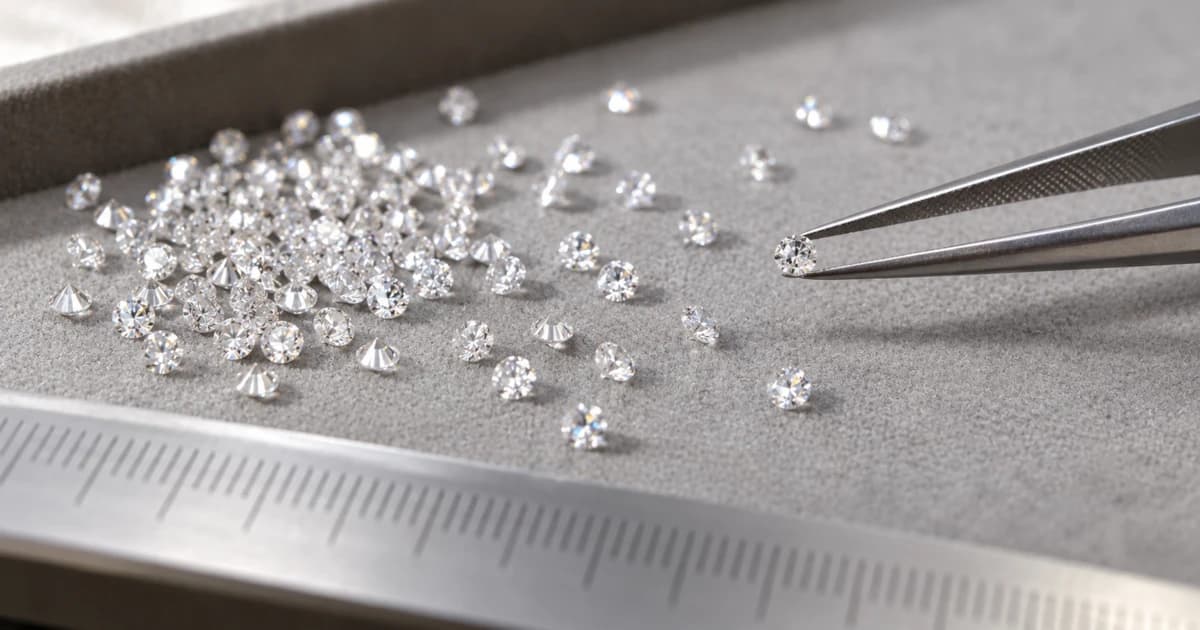
Diamond melee means small diamonds: the stones set in halos, pavé and channel rows. GIA's line is weight, not size: melee is any diamond "weighing less than 1/5 carat", in single cut or full cut. For a round, 1/5 carat is about 3.7 mm across. GIA's melee screening takes stones from 0.9 mm up to 4.0 mm, a little above its own 1/5 ct line. A 1.3 mm stone weighs about 0.01 ct, so about 100 of them make a carat.
The chart below gives those numbers for every common size. Below about 1.6 mm, though, the weight for a given diameter stops following the rule that works for larger stones, and that can move a halo's carat total by about a quarter.
Melee size chart: mm, carat per stone and stones per carat
These size classes and weights are Stuller's published tolerances for round melee (its "Diamond Size Tolerances" page, read 15 October 2026). They're one supplier's figures, not a standard. The stones-per-carat column is our arithmetic: one carat divided by Stuller's average weights.
Size class (ct) | Diameter (mm) | Average weight per stone (ct) | Stones per carat |
|---|---|---|---|
0.0025 | 0.80–0.99 | 0.0022–0.0038 | 263–455 |
0.005 | 1.00–1.15 | 0.0039–0.0064 | 156–256 |
0.0075 | 1.16–1.23 | 0.0065–0.0084 | 119–154 |
0.01 | 1.24–1.40 | 0.0085–0.0125 | 80–118 |
0.015 | 1.41–1.55 | 0.0126–0.0165 | 61–79 |
0.02 | 1.56–1.80 | 0.0166–0.023 | 43–60 |
0.025 | 1.81–1.88 | 0.024–0.027 | 37–42 |
0.03 | 1.89–2.10 | 0.028–0.036 | 28–36 |
0.04 | 2.10–2.23 | 0.037–0.045 | 22–27 |
0.05 | 2.24–2.43 | 0.046–0.055 | 18–22 |
0.06 | 2.44–2.50 | 0.056–0.066 | 15–18 |
0.07 | 2.51–2.73 | 0.067–0.076 | 13–15 |
0.08 | 2.74–2.80 | 0.077–0.087 | 11–13 |
0.10 | 2.81–3.10 | 0.088–0.114 | 9–11 |
0.12 | 3.11–3.23 | 0.115–0.134 | 7–9 |
0.15 | 3.23–3.54 | 0.135–0.174 | 6–7 |
0.20 | 3.55–4.00 | 0.18–0.22 | 5–6 |
Stuller's separate mm-to-carat chart gives one size per class. It lists 1.0 mm for 0.005 ct, 1.3 mm for 0.01 ct and 1.5 mm for 0.015 ct. Higher up, it's 2.0 mm for 0.03 ct, 2.4 mm for 0.05 ct, 3.0 mm for 0.10 ct and 3.7 mm for 0.20 ct. Stuller calls those sizes approximate. A carat is 0.2 grams and 100 points, so a 0.01 ct stone is one point.
Why small melee weighs more than its diameter suggests
For a standard round there's a shortcut. Three GIA researchers, writing in Rapaport Magazine in 2010, gave the weight of a reference round with standard proportions (57 % table, 34.0° crown, 40.7° pavilion, 2.5 % girdle) as 0.003592 × diameter³ (diameter in mm, weight in carats). GIA uses it to grade the cut of a round: it compares the stone's volume with the reference diamond of the same diameter, to see whether the stone carries weight that doesn't show face-up.
GIA built that comparison for graded rounds, not for melee parcels. Applying it to Stuller's tolerance table is our own arithmetic. For each size class we took the middle of Stuller's average-weight range and the reference round's weight at the middle of the diameter range:
Size class (ct) | Diameter (mm) | Stuller, middle weight (ct) | Reference round (ct) | Stuller ÷ reference | Depth ÷ diameter |
|---|---|---|---|---|---|
0.0025 | 0.80–0.99 | 0.0030 | 0.0026 | 1.17 | 61 % |
0.005 | 1.00–1.15 | 0.0052 | 0.0045 | 1.15 | 66 % |
0.0075 | 1.16–1.23 | 0.0075 | 0.0061 | 1.22 | 67 % |
0.01 | 1.24–1.40 | 0.0105 | 0.0083 | 1.27 | 65 % |
0.015 | 1.41–1.55 | 0.0146 | 0.0116 | 1.25 | 65 % |
0.02 | 1.56–1.80 | 0.0198 | 0.0170 | 1.16 | 63 % |
0.03 | 1.89–2.10 | 0.0320 | 0.0285 | 1.12 | 64 % |
0.05 | 2.24–2.43 | 0.0505 | 0.0457 | 1.10 | 62 % |
0.10 | 2.81–3.10 | 0.1010 | 0.0927 | 1.09 | 60 % |
0.15 | 3.23–3.54 | 0.1545 | 0.1393 | 1.11 | 62 % |
0.20 | 3.55–4.00 | 0.2000 | 0.1932 | 1.04 | 60 % |
Every class is heavier than the reference round, but not by the same amount. The classes from 1.16 to 1.55 mm run 22–27 % heavier. The classes just below and just above them run about 15–17 % heavier, and from 1.81 mm up it's 4–13 % (the classes not shown fall in the same band). Even the larger classes mostly sit above the 2–5 % extra that GIA's researchers say is most common for rounds with Excellent proportions.
Depth explains much of the peak. Divide Stuller's depths by its diameters: the classes from 1.00 to 1.55 mm are about 65–67 % deep, the classes from 1.56 to 2.73 mm about 62–64 %, and those from 2.74 mm up about 59–62 %. A deeper stone of the same width holds more diamond. Depth isn't the whole story, though: the smallest class is only about 61 % deep and still 17 % heavy. GIA's researchers say that when a round is heavier than the reference, the extra most often sits in the girdle, and otherwise in the crown or pavilion. We can't tell from a table how any one parcel was cut. But the pattern is clear: below about 1.6 mm, don't scale weights down from bigger stones. Use the supplier's own figure for that size class.
What a 0.1 mm step does to weight and layout
For stones of the same shape, weight grows with the cube of the diameter: a 1.4 mm stone weighs about 25 % more than a 1.3 mm one, and a 1.3 mm about 27 % more than a 1.2 mm. Three things follow for a layout.
The size class itself is wide. Stuller's 0.01 ct class runs from 1.24 to 1.40 mm, and its heaviest stones weigh about one and a half times its lightest. GIA's design guide warns that "melee of different sizes (even by 0.20 millimeters (mm)) may be noticeable to a customer". A 0.16 mm spread is close to that. If a row has to look even, ask your supplier for a narrower range than the class.
The carat total moves with it. A halo of 20 stones at 1.3 mm is 0.20 ct on the nominal figure. Across Stuller's 0.01 ct class it could be anything from 0.17 to 0.25 ct. Twenty stones shaped like GIA's reference round would come to 0.16 ct. So quote a halo's total as an approximate figure until the stones are picked and weighed.
The band has to fit the row. For pavé and bead-and-bright settings, GIA advises "at least a 0.50 mm border". One row of 1.3 mm stones then needs a band at least 2.3 mm wide (1.3 + 0.50 + 0.50), and 1.5 mm stones need 2.5 mm. For channel-set stones GIA asks for 1.00 mm walls on either side: 3.3 mm across for 1.3 mm stones. These are design targets. Your caster's minimums for seats and walls are a separate check, covered in our jewelry CAD casting checklist.
Carat estimates from a CAD model
A CAD file holds the stones' shapes, so their carat can be estimated from volume. Culet Studio uses carat = stone volume (mm³) × 3.52 ÷ 200: 3.52 is diamond's specific gravity (GIA lists 3.52 ± 0.01), and a carat is 200 mg. The working is on our how it measures page.
The estimate is only as close as the modeled stone. A 1.3 mm CAD stone cut to GIA's reference proportions has a volume of about 0.45 mm³, which gives 0.0079 ct. The 1.3 mm stones you buy sit around 0.01 ct in Stuller's chart. So on a 20-stone halo, a CAD estimate can read about 0.16 ct while the parcel weighs nearer 0.20 ct. Neither number is wrong: they describe different stones. CAD stones are often idealized, and the real stones will differ.
In practice, use the CAD estimate to compare designs and to check how many stones fit, and take the quoted carat total from the stones that will be set. Culet Studio's inspection report lists every stone in the file with its shape, length × width × depth and estimated carat. It recognizes center, halo, hidden halo, side stones and shank pavé from how the stones are arranged, not from layer names. Its casting checks also flag stone gaps and intersecting girdles. It measures the CAD model only: it doesn't grade or identify real diamonds.
If you're also quoting metal, our guide to calculating gold weight from a CAD file covers the other half of the estimate.
Natural, lab-grown and simulant melee
Melee is sold in parcels, often of 100 carats or more, and GIA set up its melee analysis service "to address concerns about laboratory-grown and treated diamonds being mixed into parcels of melee". The submission rules tell you what can be screened:
Size: 0.9 to 4.0 mm, about 0.005 to 0.25 ct, round and fancy shapes.
Color: D to Z only. Rounds can also be sorted into color ranges as an option.
Quantity: at least 250 stones per parcel. At 1.3 mm that's about 2.5 ct (2.1 to 3.1 ct across Stuller's class).
Results: the stones come back sorted, each group in its own secure package: natural rounds, natural fancy shapes, laboratory-grown, simulants, and stones outside the service criteria. The screening also separates natural diamonds that may be HPHT-treated.
Single cut, full cut, and where melee ends
GIA describes two cuts. A single cut has a round outline and 17 or 18 facets. A full cut is a round brilliant with 57 or 58 facets, depending on whether it has a culet. Melee can be as small as 0.001 ct.
The top of the range is less settled. GIA's line is 1/5 carat, but GIA itself says "the exact size range of melee varies from country to country and from one segment of the trade to another". One dealer puts melee below 0.15 ct, and the same dealer has written elsewhere that it is typically under 0.10 ct. Dealers may also sort melee into sizes with sieves. If a supplier quotes a sieve number, ask what it means in millimeters before you model to it.
Ordering and modeling melee for a design
Model in millimeters, quote in carats. Lay out the row with the diameter you'll order, then take the carat from the supplier's figure for that size class.
For the smallest sizes, trust the supplier over geometry. A formula scaled down from a bigger stone will read light.
Quote halo and pavé totals as approximate until the stones are picked and weighed.
Ask for a narrow size range for matched rows, not just the size class.
Check the band width against the row before the model goes to the caster.
To see the stone count and estimated carat of a design before you order, open your CAD file in Culet Studio. Files are read and measured in your browser, and a file is stored only when you save it to your Drive, share it by link, or export a live 3D or 360° view. It's free for everyone, with credit, and has no usage limits.
Related Articles
View All Blogs
October 29, 2026
Free Jewelry Design Software: What Each Free Tool Can and Can't Do
Blender, FreeCAD, Fusion, Onshape, SketchUp and the paid-CAD trials, checked against each maker's own terms: commercial use, STL export and time limits.
October 27, 2026
Jewelry Design Software Compared: Rhino, MatrixGold, 3Design and More
Rhino, MatrixGold, 3Design, ZBrush, Blender and Fusion compared from each maker's own site: price, platforms, file formats, jewelry tools, and what your caster needs.
October 20, 2026
Jewelry CAD Checklist Before Casting: Minimum Thickness, Prongs and Clearances
Eight checks for a ring CAD file before it goes to print and cast, with three casting suppliers' published minimums side by side and how to check each in Rhino.